Ageless Linux Emerges to Protest OS-Level Age Verification Laws
A new Linux distro has appeared.
Not surprisinhg. We get new Linux distributions almost every month, sometimes even every week.
This one is based on Debian. Again, not surprising. Debian has long been the mother of countless Linux distros.
But the interesting part isn’t the base. It’s the reason this distro exists.
It was created as a symbol of resistance.
That’s also not new in the Linux world. Many distros have been born out of disagreement or protest. For example, Void Linux emerged during the heated systemd controversy, offering a system that avoided systemd entirely.
The new distro, called Ageless Linux, follows a similar idea. It’s essentially Debian Linux but without age verification.
Age verification… what?
A new trend is quietly spreading across the United States: laws that require age verification at the operating system level.
It started with California, and states like Colorado, New York, and Illinois have proposed similar legislation. Reports also suggest that Brazil may be moving in the same direction.
What makes this development even more interesting is that Meta, the company behind Facebook, reportedly lobbied heavily for these laws.
Until now, governments mainly pressured social media platforms to verify users’ ages to prevent young children and teenagers from accessing certain services.
Meta’s proposal shifts that responsibility. Instead of every app or website verifying a user’s age individually, the operating system would verify it once.
Then, through an API exposed by the OS or its app store, applications could simply ask the system for the user’s age or age category.
In other words, your operating system becomes the age gatekeeper for every app you install.
And that idea has sparked a lot of debate in the tech community especially among Linux and open-source developers.
Why age verification is ‘incompatible’ with Linux ecosystem?
At first glance, age verification sounds reasonable. Governments argue that it helps protect children from harmful online content. But many developers and privacy advocates see serious problems with pushing this responsibility to the operating system.
The biggest concern is privacy. Linux distributions traditionally collect little to no personal information about users. Unlike Apple and Microsoft, you are not forced to create an online account before using an operating system. Introducing age verification could mean that operating systems must store or process sensitive identity data, something many Linux projects have deliberately avoided for decades.
Some critics suspect the push is less about child safety and more about control, warning that once operating systems begin verifying identity or age, it becomes easier to expand such systems to regulate broader online activity.
Another issue is security risk. If operating systems start storing age or identity information, it creates a new type of data that could potentially be misused, leaked, or exploited. Even if only age categories are shared with apps, it still introduces a form of system-level user profiling.
There is also a philosophical concern. Many of us in the open-source world believe an operating system should remain a neutral tool, not a platform that enforces identity verification or government regulations.
Because of these concerns, some developers and users see OS-level age verification as a step toward turning operating systems into identity gatekeepers, which runs against the long-standing Linux ethos of user freedom and minimal to no data collection.
Ageless Linux
Unsurprisingly, the age-verification proposal has raised serious discussions in the open-source world. From what it seems, most mainstream distros will enable this feature in one way or another. That includes Debian.
I anticipated this situation. I had a feeling that there would be some new distros offering “no age verification” as their main feature.
That’s precisely what Ageless Linux has done.
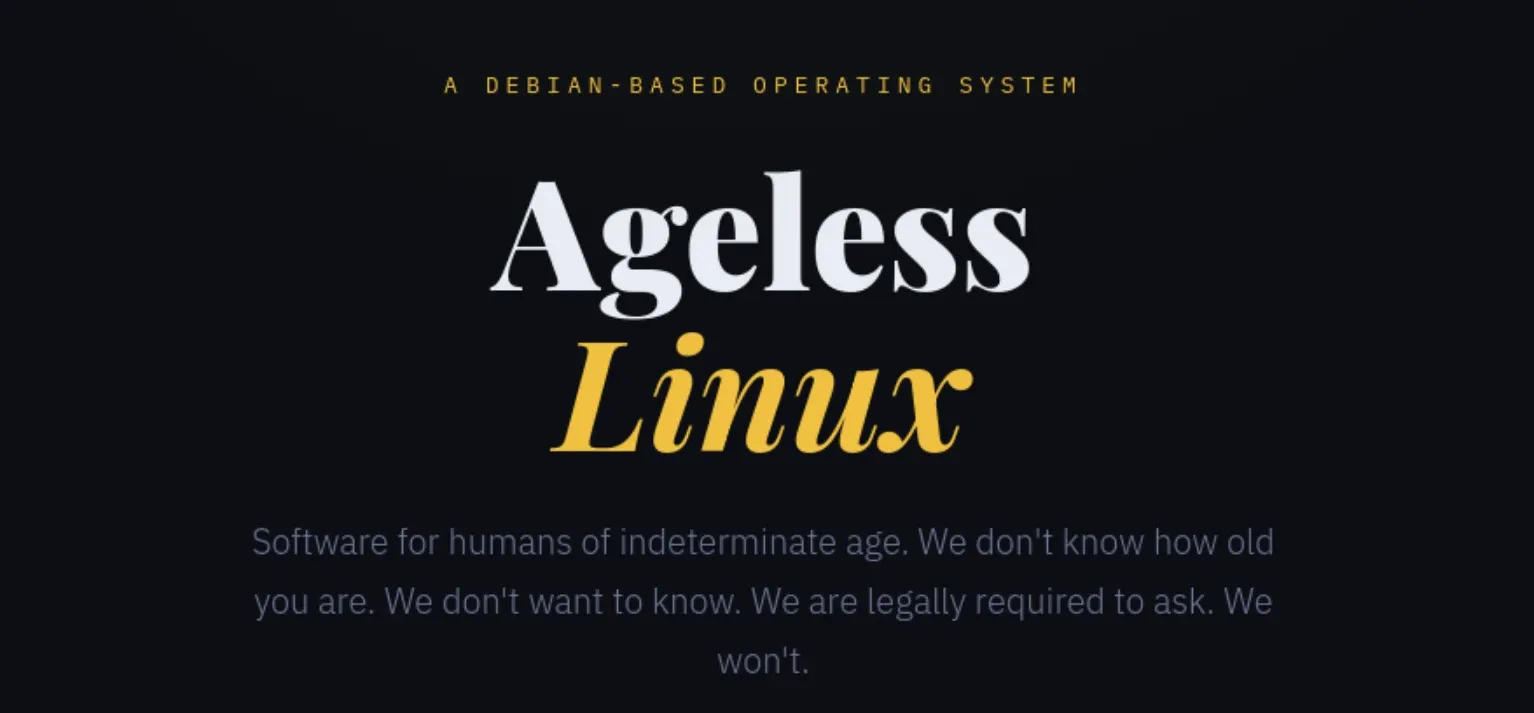
The project positions itself as a statement against OS-level age verification. Instead of building systems that identify and categorize users by age, Ageless Linux sticks to a much simpler idea: an operating system should run software, not act as a digital identity checker.
Ageless Linux is a registered operating system under the definitions established by the California Digital Age Assurance Act (AB 1043, Chapter 675, Statutes of 2025). We are in full, knowing, and intentional noncompliance with the age verification requirements of Cal. Civ. Code § 1798.501(a).
In practical terms, Ageless Linux is basically Debian with the age-verification pieces removed or avoided. The goal isn’t to reinvent Linux, but to ensure that users who oppose these laws still have a distribution that does not participate in age-verification frameworks.
More than just another Linux distro actually
I am glad that Ageless Linux did not stop at “Debian without age verification”. Browsing the website, it seems they are more of a project that stands against age verification.
They have a dedicated page, and hopefully a database in the future, that lists the stance of various distros and organizations on the age verification issue. There is a page that lists US state laws that require operating system providers to collect age data from users.
So it’s not just a distro; it’s becoming a full-fledged portal documenting and opposing age-verification laws.
In addition to that, they also have an ambitious hardware project that is “designed to satisfy every element of the California Digital Age Assurance Act’s regulatory scope while deliberately refusing to comply with its requirements.”
This hardware is basically a $12 RISC-V ARM board. They have named it “Ageless Device” and the aim is to give it to children in schools.
And I’m glad they are not restricting themselves to just a distro, but are moving toward becoming a non-profit organization that educates people about the potential dangers of age verification turning into surveillance infrastructure.
Do check them out.

Source: It's FOSS